Case Study · 01 · 2022 — Present
LaylaAI
$1B+
In trips planned
Minutes
Intent → bookable itinerary
2,004,084
TRIPS PLANNED
00 / Origin
Before Layla, there was Adeo.
Adeo was the original prototype — a social, AI-assisted inspiration engine for travelers. We were exploring how people discover places, save ideas, and turn loose curiosity into a real trip. The early builds tested the hypothesis that became Layla: a single intelligent surface can replace the dozen tabs travel planning lives in today.
The three clips below are from that era — April 2023 walkthroughs of the inspiration feed, ecosystem concept, and the first end-to-end demo.
01 · Inspiration & Explore
Feed-based discovery — taste signals captured passively as travelers browse.
02 · Ecosystem Promo
The product vision: planning, booking, and social discovery in one surface.
03 · April Demo
First working end-to-end flow — the spine that became Layla AI.
01 / Context
Open-ended intent, bookable in minutes.
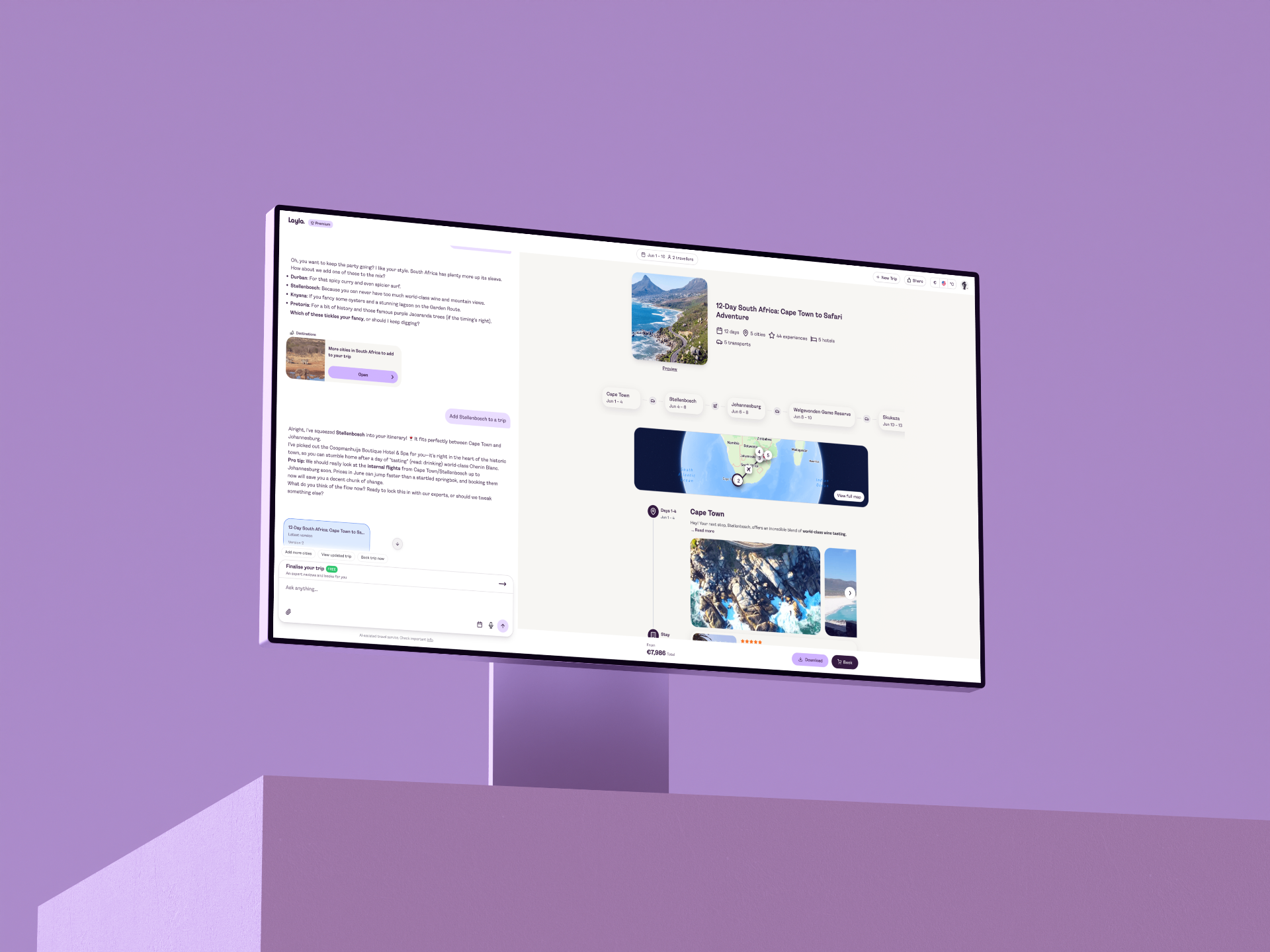
Travel planning lives in a hundred tabs — flights here, reviews there, a doc somewhere else. Layla replaces that with a single agent that learns each traveler's tastes, plans complete end-to-end itineraries, and books them.
The brief was deceptively simple: take an evolving LLM and shape it into a product that feels trustworthy enough to actually hand over your trip — and your card. In practice that meant designing for non-determinism, latency, partial knowledge, and a model that literally changes underneath you every few weeks.
We started narrow — a single conversational thread that could answer one question well — and widened the surface only when the agent's behavior earned it. Trust was the product.
02 / Capabilities
How the agent actually works.
Smart Search · Live Pricing
Real-time comparison across flights, hotels, trains, and car rentals. A flight prediction engine forecasts price trends; smart hotel search filters by natural prompts like “sea view with a rooftop pool.” Activities, experiences, and private transfers all bookable in one conversational flow — available in 16 languages.
AI Planning & Personalisation
Travelers share dates, interests, and budget; Layla builds a custom day-by-day itinerary in seconds. The conversational assistant learns preferences — romantic dinners, kid-friendly stops, off-beat adventures — and re-plans on the fly. Itineraries export as downloadable PDFs for offline use.
Visual, Interactive Maps
An Interactive Video Map overlays creators' travel videos onto destinations — Rome's Colosseum through a vlogger's lens, hidden bars in Tokyo. A Multi-Destination Route Map powers European rail journeys and USA road trips, while the Road Trip Planner suggests scenic stops, drive times, and overnight stays.
Media-Driven Inspiration
Viral travel videos and authentic creator content — drone footage of alpine lakes, foodie tours in Paris, street scenes in Bangkok — are linked directly to planning tools. Fall in love with a destination, add it to your itinerary in one tap.
03 / Who it's for
One agent, seven kinds of traveler.
01
Families
Balance sightseeing with downtime; kid-friendly hotels, activities, and transport.
02
Couples
Boutique hotels, wine tastings, sunset cruises — romantic itineraries packed with memorable moments.
03
Solo travellers
Stay safe and flexible with curated neighbourhoods and local experiences.
04
Groups & friends
Coordinate schedules, share itineraries, and manage budgets together.
05
Road trippers & rail lovers
Scenic routes optimised for driving and train times so the journey itself is the trip.
06
Business & bleisure
Efficient schedules that mix business with leisure, perfect for extending work trips into vacations.
07
Luxury seekers
First-class flights, five-star resorts, private transfers, and exclusive experiences.
04 / Approach
Design the agent's behavior, not just the screens.
Taste discovery
A lightweight onboarding that captures preference signals the model can act on — without feeling like a form.
Intent → itinerary
A conversational surface that turns vague prompts into structured, editable plans.
Trustworthy booking
Designed the moments where the agent commits real money — with the receipts, transparency, and control travelers expect.
Adaptive behavior
Re-plans when weather, prices, or your mind changes. Surfaces what shifted and why.
05 / Principles
Heuristics for a moving model.
- 01
Show your work
When the agent commits to something — a flight, a hotel, a route — the surface should make the why visible without forcing the user to ask.
- 02
One question at a time
LLMs love long answers. People don't. Each turn should ask for one decision, then move on.
- 03
Editable, not magical
Every output is a draft. Swap, remove, re-plan. The agent proposes; the traveler still owns the trip.
- 04
Adapt out loud
When conditions change, surface the diff. Silent swaps erode trust faster than any bad recommendation.
- 05
Design the moment of payment
The booking screen carries the entire product. Receipts, fine print, and clarity matter more than novelty here.
06 / Outcomes
What it shipped to.
- $1B+ in trips planned through the agent.
- 2M+ trips planned with an average 4.9★ traveler rating.
- Live integrations with Booking.com, Skyscanner, and GetYourGuide — real inventory, real prices, one checkout.
- A consumer-grade AI product used end-to-end — discovery, planning, booking, and in-trip support across 16 languages.
- A design language and set of interaction patterns other agentic products are starting to look like.
Reflection
“Designing for an LLM is less about screens and more about behavior — what the agent does when no one is looking, and how it tells you about it after.”